A. S. Byatt's Ragnarök
Once upon a time, there was something rather than nothing...
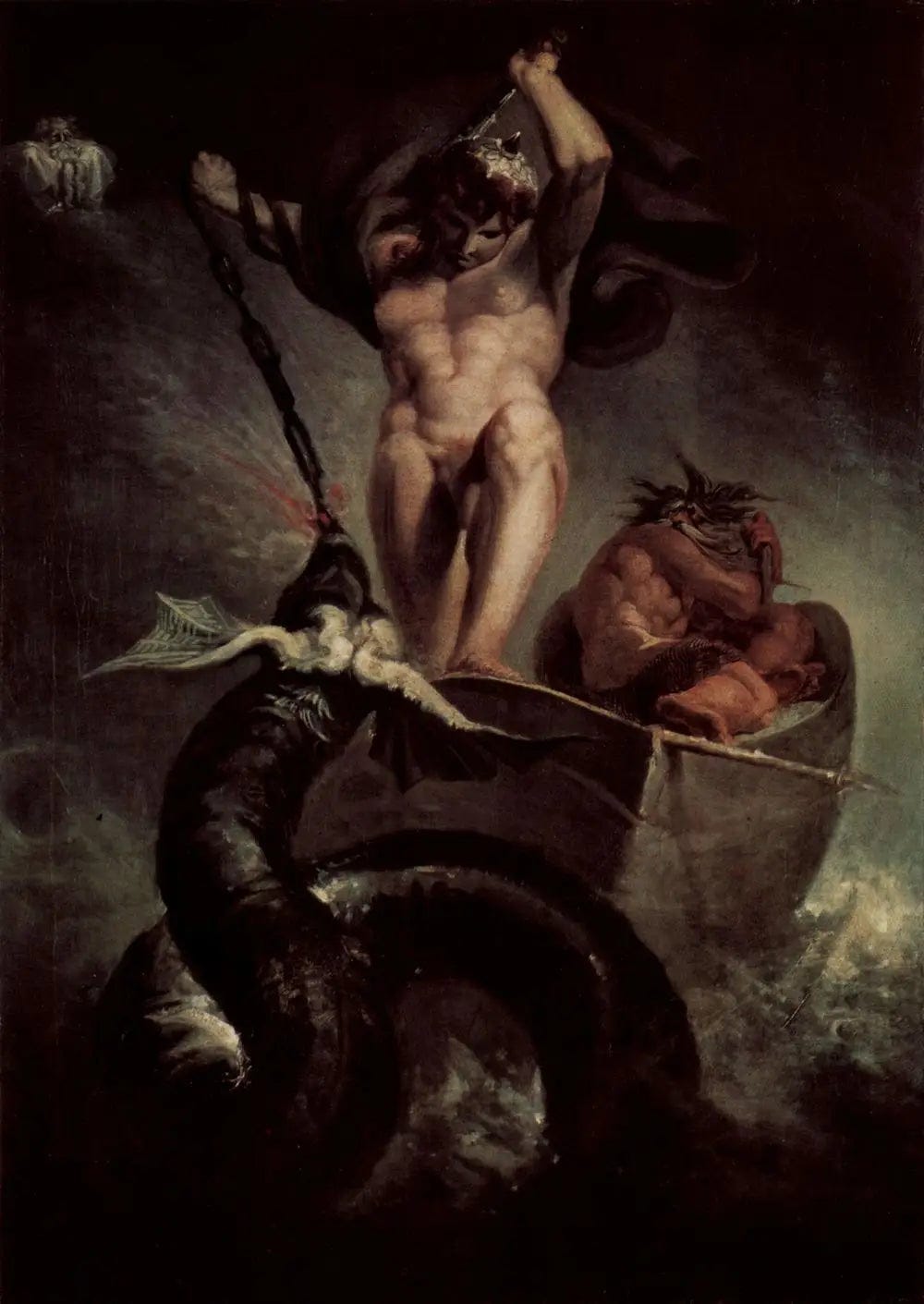
A. S. Byatt. Ragnarök: The End of the Gods. Canongate, 2011. 177 pp.
Byatt’s name was huge to a fiction-enjoyer growing up in the early aughts. This prestige rested on her work in the nineties with meta-historical works like Possession. The Children’s Book was a big deal in 2009.
Your host read Possession (1990) many years ago, and certain images (like vegetation likened to pubic hair in a lesbianic ode, and a campy scholar’s presentation) resonate to this day.
Ragnarök (2011) was Byatt’s contribution to Canongate’s Myth series, which also has books from Atwood, Winterson, Ali Smith, Tokarczyk, and Victor Pelevin — do these sort of commission-based series even get organized anymore?
(During my grad school days, Hogarth Press had started publishing a line of Shakespeare retellings by famous authors, including Winterson and Atwood again. But that appears to have fizzled out: the series website began redirecting to “Anime Shakespeare,” and then went down entirely, which feels suggestive.)
While it’s much shorter than Children’s Book, all of Byatt’s concerns with myth and historical forms and how they’re brought to bear on modern period novels come to a head with this treatment of the Norse myths.
Ragnarök is also Byatt’s last novel. It’s normally tempting for the critic to read a summating statement on writing and narrative from a final work like this. There are, however, some extra elements that make this text a semi-fiction, not least of which is an extended afterword on mythology, as well as a bibliography organized by topic. It has an expository flow, includes illustrations and extended quotes, and is willing to show its research. Basically it read to me as a much tidier version of Vollmann’s books.
The frame for Byatt’s exploration of the twilight of the Norse gods is the girlhood of a “thin child.” Her father has gone to World War Two, while the rest of the family retreats to the countryside, away from the German bombing. “At the end of every year the family sipped cider and toasted his safe return. The thin child felt a despair she did not know she felt.”
She finds solace in this solitude through reading a copy Asgard and the Gods, replacing daily sights with visions of giants and dragons. The pleasure of reading is not exactly pictures but word-pictures:
She knew, but could not have said, that it was the precise degree of formlessness in the nevertheless scrupulously depicted rocks that was so satisfactory. The reading eye must do the work to make them live, and so it did, again and again, never the same life twice, as the artist had intended. She had noticed that a bush, or a log, seen from a distance on her meadow-walk, could briefly be a crouching, snarling dog, or a trailing branch could be a snake, complete with shining eyes and flickering forked tongue.
Even though the prose is even-toned and stays at this leisurely pace, there are genuinely Joycean moments, where Byatt’s literary attention goes to the phonic level, and even something like the long list of fauna surrounding Randrasill (Byatt’s fictional ocean counterpart to the world tree) sounds off musically:
The Sea-Tree stood in a world of other sea-growth, from the vast tracts of bladderwrack to the sea-tangles, tangleweeds, oarweeds, seagirdles, horsetail kelps, devil’s aprons and mermaid’s wineglasses. Shoals of great fish and small fish went by, wheeling packed globes of herring, rushing herds of tunny.
The thin child’s reflections are a chance to clarify the reader’s relationship to myth, as opposed to a religious book of faiths or an allegory like that of Bunyan’s. “She did not believe the stories in Asgard and the Gods. But they were coiled like smoke in her skull, humming like dark bees in a hive.” Myth persists “inside” us in a way that fantasy and fairytale creatures don’t.
Myth is also of course highly distinct from modern bourgeois fiction:
The thin child, reading and rereading the tales, neither loved nor hated the people in them — they were not ‘characters’ into whose doings she could insert her own imagination. As a reader, she was a solemn, occasionally troubled, occasionally gleeful onlooker. But she almost made an exception for Loki.
That’s because Loki’s shapeshifting and mood swings, his very instability makes him the most recognizably human, amongst all these one-note gods and heroes.
One-note indeed. The gods are so obviously unreal and unhuman to the thin child because of their unchanging natures, doing the same things over again while never getting bored—what could be more unrecognizable to a human?
The gods celebrated the cohesion of earth, air fire, water and all the creatures in an on these elements. They celebrated as they might have been expected to, with fighting and shouting. They had a kind of playground scuffle in which everyone ganged up on one unarmed victim, only in this case the centre of the scuffle was Baldur the victim, standing there peaceably, mildly proud of his invulnerability. They threw things at him, all kinds of things, everything the could. Sticks, staves, stones, flint axe-heads, knives, daggers, swords, spears, even in the end Thor’s thunder-hammer…It was the best game ever invented. The gods laughed and smiled and threw, and threw again.
No wonder the thin child is merely an “onlooker,” like a spectator at the opera — for a production of Wagner’s Ring cycle, naturally. It’s probably how the gods look down on us in Midgard as well.
Mythology itself is fundamentally opaque. The memory of the myth is a “blackness” in the mind.
The black thing in her brain and the dark water on the page were the same thing, a form of knowledge. This is how myths work. They are things, creatures, stories, inhabiting the mind. They cannot be explained and do not explain; they are neither creeds nor allegories. The black was now in the thin child’s head and was part of the way she took in every new thing she encountered.
Byatt in her afterword hits on the same point as above, that the significance of reading about the Ragnarök as a child lay in revealing the distinction between myth and fairy tales, the later being essentially meta.
The myth’s didn’t give me narrative satisfaction like fairy stories, which seem to me to be stories about stories, to give their reader the pleasure of recognising endlessly repeated variations on the same narrative patterns. In fairy stories — if you accept the bloody violence, and the horrible things that happen to the bad characters — the point is a pleasurable and satisfactory foreseen outcome, where the good survive and multiply and the bad are punished.
The events, transformations, and outcomes of myth are inscrutable compared to the moralism of fairy tales.
But what does it mean that this blackness, this presence of absence of meaning, plays such a foundational role for western culture, to say nothing of Byatt’s own work? And how is the significance of the black in our present-day conditions different from in the past?
It’s quite a cerebral note to end on, and fittingly apocalyptic too. Myths and legends emerge in a social formation that, in Marx’s words “overcomes and dominates and shapes the forces of nature in the imagination” only. Myth turns black when the control of natural forces becomes actual.
Byatt’s text evokes plants and creatures and ecosystems, as well as climate change and overfishing: what is the new significance of myth, if any, should nature’s turn to dominate once again come to pass?