Brian Evenson's Open Curtain
Brigham Young? More like kill 'em young...
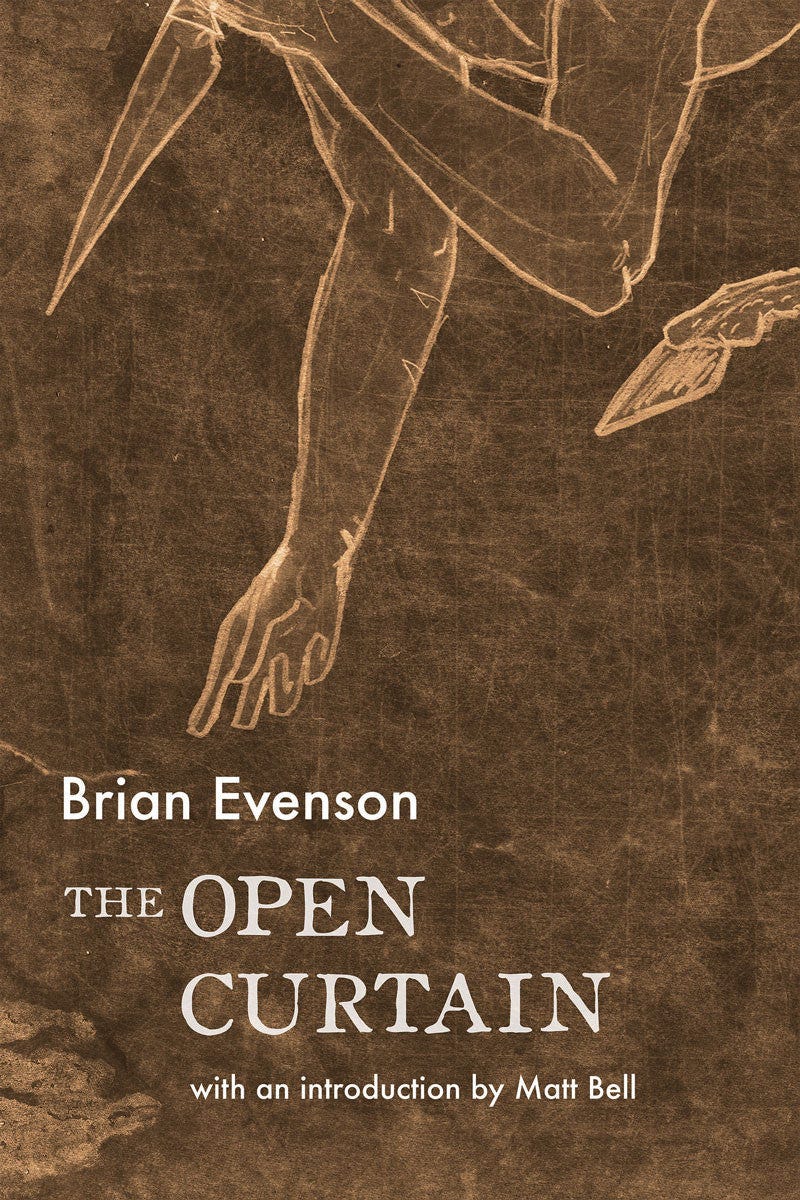
Brian Evenson. The Open Curtain: A Novel. Coffee House Press, 2016 [2006]. 240 pp.
BRIAN EVENSEPTEMBER continues with The Open Curtain, another novel of grisly, sadistic crime, but also a lingering character study rather than a case file. It’s clearly another station on Evenson’s autobiographical journey out of the LDS church, after the moralistic attacks on his earliest published stories. Father of Lies dwelt on the institutional power that breeds and protects predators and pederasty. The second novel, longer and more ambitious, has an expansive voice that tells of a journey of the mind to the Devil.
It’s a story of spiritual anguish and the trauma of separation at the personal level: “By the time I finished [The Open Curtain],” Evenson writes in his afterword, “I had left the Mormon Church of my own volition.”
This work is a big step up, in scale, complexity, and aggressive strangeness. First of all, it includes more historical documents. The protagonist Rudd, like the author when he was younger, takes an interest in the 1902 murder of Anna Pulitzer by William Hooper Young, grandson of Brigham Young. Evenson additionally draws on the Lafferty murders of 1984, another Mormon-adjacent and LDS-inspired killing. It’s as if these past skeletons had been collectively repressed by the Mormon community.
But this documentary material is just the springboard into a weird apocalyptic narrative that doesn’t withhold information, so much as patiently let the disaster play out over months and years. And the narrative went ballistic for the finale.
Rudd is an only child with an overbearing widowed mother. He’s raised in a strict Mormon upbringing. Father of Lies was about a fringe church called “Blood of the Lamb,” a clever choice since it doesn’t point to any single denomination while sounding out the themes of sacrifice and fundamentalism. But now we explicitly face the LDS and its doctrines.
Rudd is bitter and powerless about his situation, but finds means to cope:
When reading aloud, he found, you couldn’t pay attention to what you were reading; your jaws were too busy moving and slipping around the words trying to make the archaic sentences sound like they make sense. You felt no substance, but there was a formal satisfaction to the act. When, at home, in his daily scripture study with his mother, he asked if he could be the one to read from then on, she was ecstatic, saw it as a sign that he’d finally taken an interest in the Church. But it wasn’t that, not at all.
Rudd takes interest in the Anna Pulitzer killing, and is fascinated by the ritualistic sacrifices of the Mormon temple that inspired the murder method. Rudd discovers evidence that his father had a son by another woman, which his mother of course harshly denies, but he doesn’t let go of any of these fixations.
Before page 20, Rudd has apparently tracked down his half-brother Lael at his home in the next town over. And at this point, with a quest completed so quickly, your host enjoyed one of those moments of not really knowing how this plot will unfold.
Rudd and Lael develop their friendship, and Rudd learns more about the murder, like how Young himself had blamed a third man for the killing. The prose, employing limited third, is more relaxed than Father of Lies and stays focused on Rudd’s psychic states as he goes further off-kilter in his relationship with Lael.
As if the weekly proximity to Lael had weakened his skin and let his brother leak in. As he rode on the back of the scooter, his face pressed against Lael’s back, he felt that even once he was separated from him he would be joined to him still.
It gets worse as we learn Rudd is periodically blacking out, with hours going unaccounted for. (And nobody else seems to acknowledge Lael’s existence, either.)
He felt almost as if he had two brains, each entirely independent of the other, and that he clicked back and forth between them for reasons unknown to him. He was lodged entirely in one brain. He could not say who had taken up residence in the other.
The novel here breaks into a new part, and pivots to the perspective of Lyndi, the only survivor of a brutal crime at a campsite, in which her family (also devout Mormons) was annihilated by stabbing. The wound patterns resemble that of the LDS temple sacrifices.
Rudd is also one of the victims, found with wounds at the scene of the familicide, and eventually he and Lyndi develop a connection. Rudd moves into Lyndi’s family home but sleeps in a separate room. He’s a selfish and difficult roommate/significant other, which you can tell from the contrast from after he harms himself:
He was normal now, she thought, subdued. Having his throat slit a second time had made him tractable. He had, at least temporarily, become a good listener, would sit still as she talked, answer only if he was asked a direct question or given a cue. She had the upper hand for once, she thought, knowing it was a mistake to think of relationships in such terms but thinking in them anyway.
Lyndi unfortunately agrees to marry Rudd, and the sequence of their wedding is an uncomfortably funny initiation in the temple — reminiscent of Pierre getting inducted to the freemasons in Tolstoy’s War & Peace, with a lot of awkward whispering and fumbling. The literal curtain is here too, but what horrors will be revealed by the parting of this veil?
The climax, which switches back from Lyndi to Rudd, is an astounding set-piece that reads as an existential nightmare: Rudd finds himself thrown into the early 20th century, the surroundings of William Hooper, unable to fully recollect who he is or what he’s trying to do. Post-it notes litter the scene with instructions, like in a Philip K. Dick story.
Worse, this abstract scenario, with its liminal setting and amnesiac hero, begins to arbitrarily reset itself, like a survival video game reloading it’s initial state over and over again. The opening line of this part of the book gets reiterated three times.
It took him a moment to understand where he was.
It took him a moment to understand where he was.
For a moment he was not certain where he was.
Soon it becomes clear that Rudd’s self is dividing, similar to Fochs in Father of Lies, and Lael is directing him, as a handler controls a spy out in the field.
Bleak, thrilling, and quite enjoyable to read: and now it may not even be the most messed-up thing to take place in Utah!
Next week: one more Evenson, and later on a review of a brand-new novel for subscribers.