José Eduardo Agualusa's Practical Guide to Levitation
The lizard that learned too much...
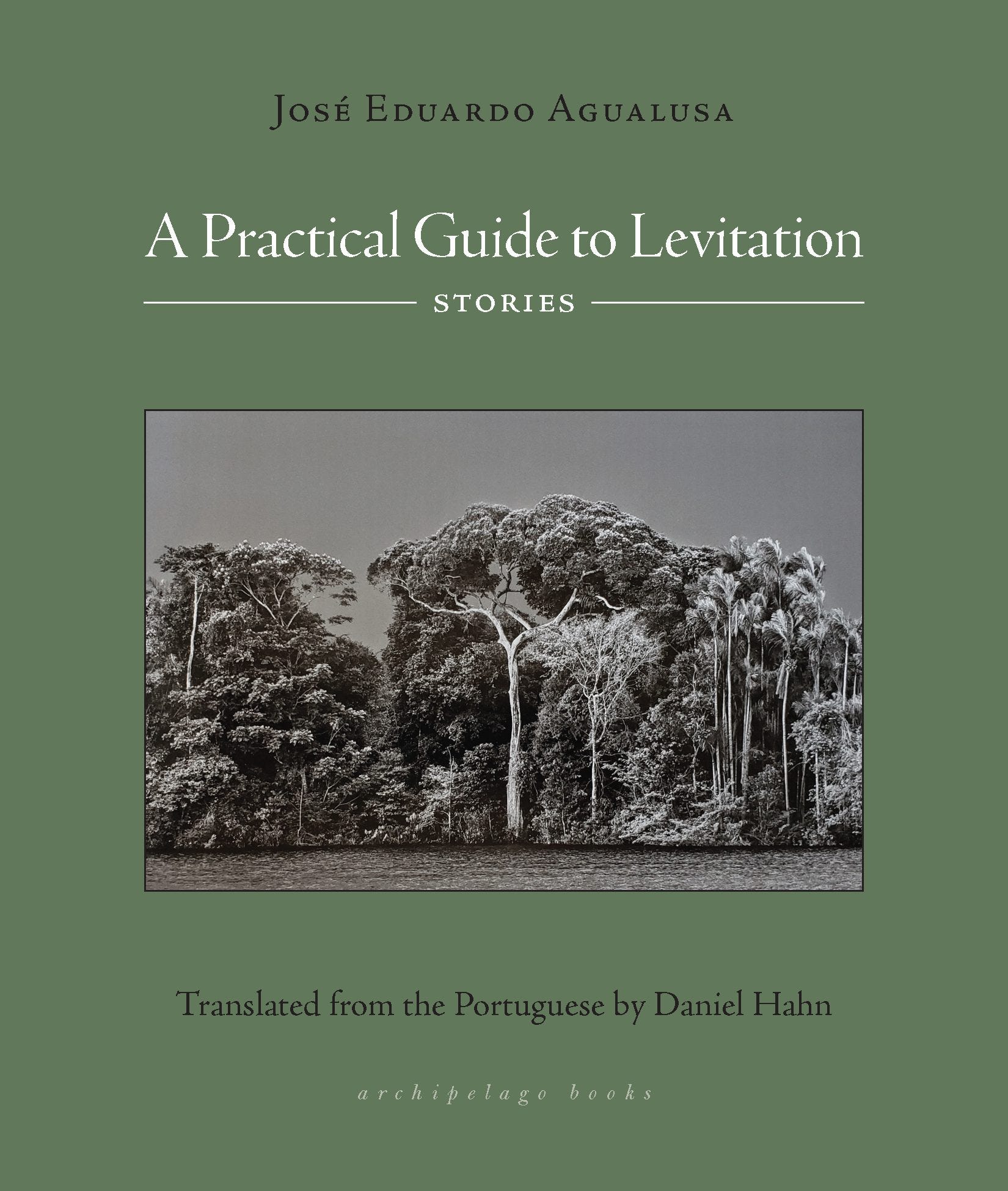
José Eduardo Agualusa. A Practical Guide to Levitation: Stories, translated from the Portuguese by Daniel Hahn. Archipelago, 2023. 240 pp.
For this Sunday evening edition of the ‘stack, a brief notice on one of the most prominent names in Portuguese-language literature.
This year I got into the curiously jarring fiction of the Angola-born José Eduardo Agualusa. His recent novel The Living and the Rest was published in translation earlier this summer. I’m still shopping around a review piece, but it’s an extremely impressive novel, both about writers and writing literature as well as a dive into fabulation and tall tales.
It’s quite deft about the political angle to its subject matter, too, namely Mozambique’s situation and the rest of the capitalist states in Africa whose national liberations and civil wars in the 70s are in a remote, misty past for these characters.
Living and the Rest includes a journalist, Daniel Benchimol, who also features in the prize-winning General Theory of Oblivion. He may very well narrate at least a couple of the pieces included in the book before us, A Practical Guide to Levitation.
This book is actually a compendium project led by Agualusa’s regular translator Daniel Hahn (see also Diamela Eltit’s Never Did the Fire). The many brief narratives bound in this book span the author’s entire career.
Archipelago books are usually nice as books, but there’s something extra satisfying about this one. First the lovely muted green color, like tree leaves mixed with ash. Second, the monochrome photo by Salgado, taken in a national park in Brazil. The dense jumbling of tree trunks and foliage along the placid river water resembles the stories in this book.
The prose is incredibly simple, beyond Bolaño’s or Coetzee’s kind of simplicity: it’s a faux naïf style that lets the author stay open to any elements that may come through. If the story ends up being about Borges waking up in hell, so be it. Such a stark style allows the fiction to stay forever porous, dramatized in the common occurrence of imaginary and historical characters to interact.
Sometimes our characters appear in our real lives, and by the time we’ve noticed, they’re already embedded in the pages we’re working on, chatting away, suffering, loving, leading the action. We understand at once that some of them do not belong to our universe. They are fantasy characters. They infiltrate reality through some artifice, or simply by mistake. The latter sort, the wayward ones, can’t wait to get back to fiction. They look at a writer and see a crosser of borders. They seek us out so that we might lead them back over to the other side.
I’m pretty sure every image in this passage (which is just the narrator’s musings before meeting the daughter of Angola’s first dictator in a restaurant) turns up in The Living and the Rest, a text obsessed with borders, “liminality,” and bridge-building.
Many, if not most of these pieces, I wouldn’t be surprised to learn, could just as well be from strange things Agualusa has actually seen in Angola and his travels as a journalist, like a guy who let a mulemba tree grow around a safe that he never opened. “Whenever I go to Luanda, my friend takes me to pay a visit to the mulemba. If you push the branches aside, you can still see the safe. I put the palm of my hand onto the metal and feel the mystery pulsing within.”
One memorable anecdote tells of the President of the US one day suddenly speaking a different language:
The president of the United States of America had indeed spent days trying to make himself understood by his family, his doctors, secretaries of state, advisers, in competent Portuguese — and with a lavish Porto accent! He did not know himself, however, which language it was. He needed to be shown where Portugal was on a map. The president became angry. ...
It wasn’t easy for him to accept that he could only express himself in a distant little dialect, part-Latin and part-Arab, spoken by a handful of Spaniards in a tiny little rectangle on the fringes of Europe. They explained to him that, no, Mr. President, Portuguese is the sixth most widely spoken language in the world. Brazilians speak Portuguese, too, and so do some African peoples.
Both of these perspectives resonate with the global literary situation. On the one hand, Lusophone literature is a peripheral one — as all languages are to English, at this point. On the other, its literature is an amazing and unique cultural circle that includes Europe, Africa, and Latin America. These are all reflected in the lighthearted episodes, light even as they go into 500 years of war and colonialism.
The direct interaction with older writings from the 16th and 17th centuries is one of the most particular aspects of reading Portuguese-language authors. Like the great Antunes, Agualusa engages with the epic of Camoes, as well as historian-memoirists of the conquest and reconquests of Angola. The latter, Cadornega, is said here to have “spoke Quimbundo with all the elegance of a true son of the land.”
And Agualusa supplements these writers with 20th century and contemporary writers as well. The surface “naivete” of his fiction, that allows for art to change social reality, and for hope and mutual understanding to coexist with colonial rapine and modern imperialist savagery, allows for an amoral entanglement with a rich literary heritage, whose riches are entangled with the earliest forms of imperialism — all of which is as quietly transgressive as it is fascinating.