Joy Williams' Harrow
Reading Kafka with my Tata...
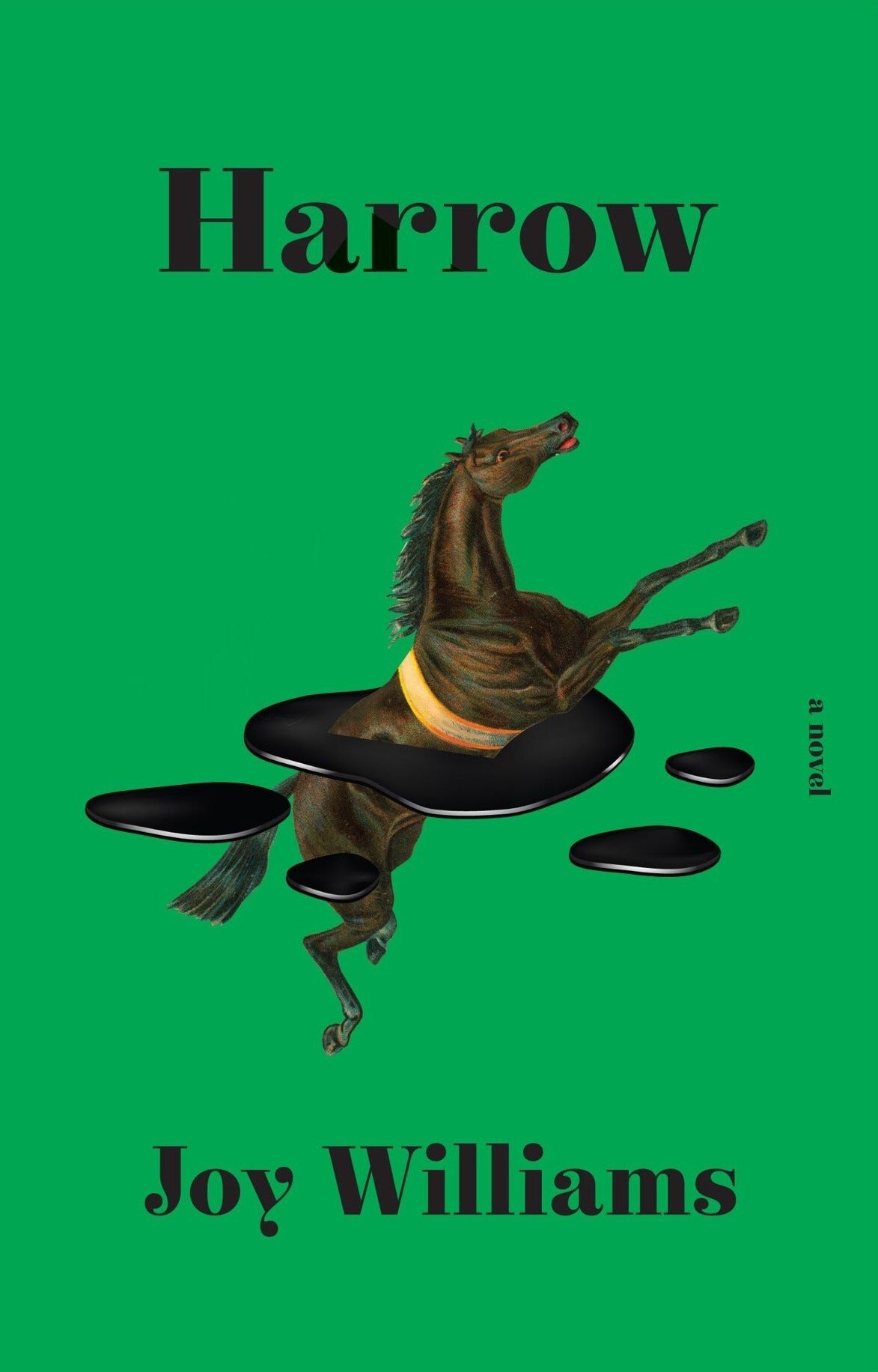
Joy Williams. Harrow: A Novel. Vintage Contemporaries, 2022 [2021]. 204 pp.
Welcome to post-apocalypse USA, which is indistinguishable from pre-apocalypse USA.
Those words at least are what came in mind reading this short novel from Joy Williams which was very funny. It starts off as a send-up of various young-adult novel tropes, and when it’s over the reader has traversed a North American ecological and cultural “Wasteland.”
But at least in Eliot’s Wasteland, the detritus promised to add up into a new point of view with a highly expanded cultural context, one that was better than the “Eurocentered” canon of fine art. Here the Wasteland is of various motifs, caricatures, and tiny narratives — this novel felt like Williams’s stories loosely strung together — and the context of each just chaotically exists on a single level.
That level comes to us in the flow of pattering dialogue. This chatter amongst the characters is a great read, full of banter, anecdotes, and compulsive quoting from literature and movie cliches (“I could get killed for this”) to an unknown effect, even to the figures in this landscape blighted by ecological ruin.
The protagonist is a young woman named Khristen, who, her mother insists, had been dead for a period as a baby. (Which itself happened under absurd circumstances in which her mother was caught in an affair.) No one else is convinced that baby Khristen had been actually dead, and the doctors say she’s fine. Nevertheless this has put a good deal theological baggage on her life.
She became more and more convinced that I had died that night and had witnessed ruthless and troubling mysteries which it was essential for me to recall. I had experienced a great reversal and my life, or whatever it was that had been restored to me, must be subject to the most delicate and definitive interpretation.
It’s likely Khristen hadn’t been “unconscious” for such a long time or was even just sleeping before she was woken by her panicked mother and “born again.” This mystical narrative of probing into another world, and all its implications of the harrowing of hell by Christ and thereby his universal love — it could all rest on a fluke and a misunderstanding.
Khristen is sent to a boarding school by train (like a certain fantasy series), and at the station she notices “a large painting of a harrow on the wall.” This image from a public mural, like the rest of this novel’s elements, get distorted and devolved in the post-apocalypse, as the harrow becomes a runic symbol over hovel entrances.
But for now, the train sequence serves for a flavor of the book’s comedy:
In the beginning the only other passengers on the train were sociologists. They ignored me. There was nothing about me to inspire their interest. Still, their disappointment with one another was obvious. Each had hoped to encounter an artist, a poetic and drunken prelate, perhaps, a botanist, even a professional athlete or doomsday commentator. This is what the great trains of literature were supposed to provide. But all were sociologists, social workers, social engineers, sociobiologists.
Clearly it’s not my grandma’s social cross-section fiction. Every artist entangled in academia for survival may pine for bohemian authenticity but what hope is there when the poets had entered the linguistics departments half a century ago?
I need to read more of Williams’s work but she’s talked about militant environmentalists and the US brand of hedonism before, and these motifs are present here too, like in the mother of schoolmate Brittany:
Her name was Freida and she described herself as an eco-critic, an authority on what she referred to as “the verge.” The country was on the verge and had been for some time, the verge that people thought would go on forever. The hiking trails, the aquariums, the infertility treatments, the oxygen nutritional supplements continuing in cheerful tandem with the oil-soaked birds, the twelve-lane highways with bicycle supplements, the tailings dumps and filthy rivers and deserts blackened with solar panels, the billions of plastic bags translated in magical symbiosis into ethically responsible leisure equipment. Freida enjoyed a flourishing career addressing the verge,…
But the coming-of-age setup gets disrupted by an apocalypse experienced vaguely and indirectly:
…as the days I moved through seemed hesitant, as though waiting for something further and not to their benefit to be decided. The people I saw didn’t seem to be traveling. They were milling, like little flies after a rain. Hope no longer found a place to dwell. Even the insects felt it gone. The colt, the cub, the calf, the stones that would be precious jewels deep within the earth. The flowers who, as Wordsworth knew, enjoyed the air they breathed, were aware of nothing but hope’s absence. Something definitely had gone wrong. Even the dead were dismayed.
And we hard cut — or break into Book 2 — to an institute by a poisoned lake called Big Girl. “Poor old Big Girl. A crow could not be made blacker than her sick waters.” The building is now a refuge of geriatric ex-scientists and savants. Khristen has drifted here (her parents not to be seen again) and we literally go door-to-door and meet a series of eccentrics with small stories.
Two behavioral scientists who specialized in introducing psychopathology in primates. They began by raising infant monkeys in stainless steel chambers with no contact with any other living thing, thus inducing irreversible mental illness. They’d gotten a few papers out of it. But then they wanted to go beyond raising them with no mothers, they wanted to see what would happen if they provided them with puppet mothers made of hair and cloth, monster mothers who would erratically and without warning eject brass darts or high-pressure compressed air that would blow the infants’ skin practically off their bodies.
That’s another motif I forgot to mention, the animal product testing. “They found it interesting how the legendary mothering instinct could be so systematically eliminated. They got a few more papers out of this and then retired.”
In a meeting room called “Launderey” these grotestques confer for organizing business, and the hysterical dialogue carries the reader along. “What will you be doing to further our agenda, Khristen? Maybe you should kill all the poets. Is that something you’d be good to do?” This is Gordon, a man of “ravaged skin” full of trapped insects. “I’m not teasing. Killing all the poets has been a consideration for some time. They’re so repulsively, tremulously anthropocentric.”
Another woman, Honey, was lionized for accidentally killing a land developer with her car. He had been “driving to close on a refugium of international significance. The elitists and extremists and anti-humanists who thought they’d secured the refugia aspects of the refugiums long ago at considerable cost and compromise found they hadn’t at all.” At the hospital she stumbles on a cell of like-minded anti-social scientists, but when the development scheme goes through anyway the same “following” turn on Honey just as quickly.
Khristen falls in with a mother and precocious son, Freida and Jeffrey, the latter at the end appears in a judge’s robe and discourses on Kafka’s Gracchus story. As weird and breezy as this book is, it does keep transforming all the way to the last page. We’ve talked about her short fiction on the stack before, and Williams is standing out in reflecting on the climate issue and our current spiritual orphanhood, specifically through her language.