Olaf Stapledon's Sirius
[BONUS] Better a dog for a lover than no lover at all...
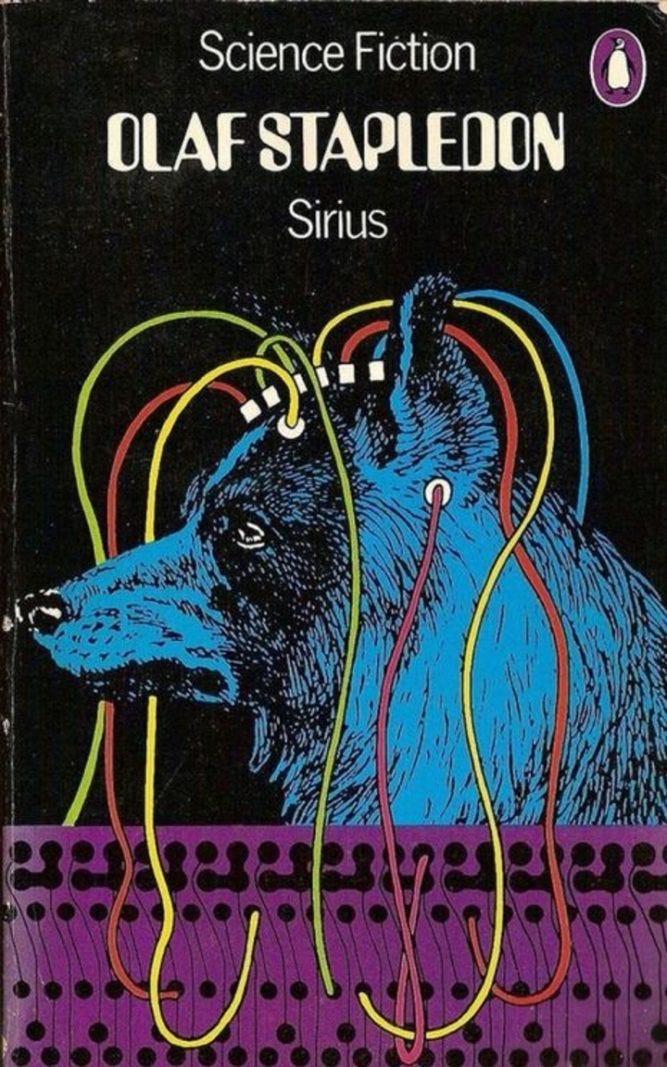
Olaf Stapledon. Sirius: A Fantasy of Love and Discord (1944). Gollancz, 2011. 194 pp.
Considering the golden age SF novels recently programmed for our subscriber-only letters, from the lyrical anarchic comedy of Lafferty to the neo-Voltairian ludic thoughts of Sheckley, my appreciation for the satirical and philosophical roots feeding twentieth-century science fiction. All of these pulp magazine writers now seem like so many Borgeses.
SF is, in Stapledon’s slogan, Histories of the Future. It’s the news from nowhere (William Morris). The “harder” iterations of SF read as pastiches in the form of scientific reports, and what dry reporting it can be, especially with this author.
Probably because Olaf Stapledon was a trained academic, PhDs in philosophy and psychology, before writing best-selling novels. These books, like Last and First Men (1930) or Star Maker (1937), concern universal history at such a cosmic scale as to effectively found a new mythos.
These long durée projections trace their roots in English utopian socialism, as cherished and continued by the Fabian Society, of which Stapledon was a member. The likeness comes to mind in particular because of Shaw’s play Back to Methuselah (1922) on the future evolution of humans.
Stapledon had an optimistic evolutionary vision, that was really a mechanical materialism: the ‘survival of the fittest’ applies to society as well as nature, and evolution will produce a Nietzschean Übermensch who will guide the masses to socialism.
The vision is more than a bit unfortunate, though it was a large part of turn-of-the-century petty-bourgeois socialism. This naïve or accidental proto-fascism is a necessary hurdle to reach a prose that, while dry like I said — dry enough that it took a couple attempts to get through the book — it’s still well-written.
And it’s funny yet appropriate that Stapledon’s novel about a talking dog will be, according to Brian Aldiss, his most human of stories.
